In today’s cloud-first, automated environments, machines interact more with each other than with humans. These interactions are powered by non-human identities (NHIs), including service accounts, APIs, bots, and workload identities. If left unmanaged, these identities can become a major entry point for attackers.
Yet, while organizations invest heavily in securing human users, non-human identity security often remains overlooked, leaving a blind spot that attackers are increasingly targeting.
This is where identity fabric security becomes critical: extending unified identity visibility and control beyond human users to include service accounts, APIs, workloads, and automation across the enterprise.
Why non-human identities are a cloud security blind spot?
- Volume and velocity: Non-human identities (service accounts, APIs, workloads, bots) often outnumber human identities by 10x or more in cloud environments.
- Static credentials: Many NHIs rely on long‑lived secrets, hardcoded keys, or static API tokens, making them prime targets for compromise.
- Limited visibility: Traditional Identity and Access Management (IAM) tools focus on human users, leaving NHIs unmanaged or poorly inventoried.
- Privilege creep: NHIs often have excessive permissions because they’re created for automation and convenience.
Understanding the expanding non-human identity landscape
- Explosion of NHIs: In cloud-native architectures, every microservice, container, and automation script needs credentials. This creates thousands of NHIs per organization.
- IAM gap: Traditional IAM frameworks were designed for humans, not machines. NHIs often bypass MFA, behavioral analytics, and HR-driven lifecycle processes.
- Shadow identities: Developers frequently create service accounts or API keys without centralized governance, leading to identity sprawl.
How attackers exploit non-human identities: Common attack scenarios
- Credential theft: Attackers steal hardcoded API keys from GitHub repos or CI/CD pipelines.
- Privilege escalation: A compromised workload identity with broad permissions can pivot across cloud resources.
- Supply chain compromise: Malicious actors inject code into automation bots or third-party APIs, leveraging their trusted identity.
- Persistence via NHIs: Unlike human accounts, NHIs often lack monitoring, so attackers maintain access unnoticed.
The rising risks of non-human identities
As cloud adoption and DevOps automation accelerate, the risks associated with unmanaged non‑human identities are increasing sharply.
- Service principals that grant applications access to resources
- Automation scripts using stored credentials or secrets
- APIs exchanging sensitive data across workloads
- Containers and CI/CD pipelines running with broad privileges
These identities often:
- Operate 24/7, making anomalous behavior harder to detect
- Hold excessive or unmonitored privileges
- Lack lifecycle management — credentials are rarely rotated or decommissioned
- Are created by automation tools without centralized oversight
A compromised service account can open direct access to production data, cloud control planes, or lateral movement across environments — without triggering traditional user-based alerts.
Risks of ignoring machine identity security
- Supply chain attacks: Compromised API keys or service accounts can lead to lateral movement across systems.
- Data exfiltration: Bots and workloads often have direct access to sensitive data.
- Persistent access: Attackers love NHIs because they rarely rotate credentials and often bypass MFA.
Common non-human identity governance gaps
- No centralized inventory of machine identities — scattered across cloud, DevOps, and on-prem systems.
- Over-privileged roles — service accounts often have “Contributor” or “Admin” access for convenience.
- Lack of ownership — nobody explicitly “owns” these identities, making remediation unclear.
- Weak credential hygiene — secrets are hardcoded in scripts, Git repositories, or configuration files.
- Inadequate monitoring — identity logs for service principals and workloads are rarely analyzed.
A framework for non-human identity governance
Building a strong Non-Human Identity Governance framework involves three key pillars — Visibility, Control, and Automation.
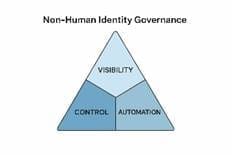
Visibility – Discover and classify machine identities
- Build a centralized inventory of all non-human identities (service accounts, API keys, tokens, workload identities).
- Classify identities based on criticality and access scope — production vs. test, internal vs. external APIs.
- Leverage cloud-native tools (e.g., Azure AD, AWS IAM, Google Cloud IAM) and identity threat detection solutions to surface unmanaged or orphaned identities.
Control – Enforce least privilege and lifecycle policy
- Apply Role-Based Access Control (RBAC) and Attribute-Based Access Control (ABAC) principals to machine identities.
- Rotate credentials and API keys periodically using secret management platforms like Azure Key Vault, HashiCorp Vault, or AWS Secrets Manager.
- Ensure every service identity has a clear owner, purpose, and lifecycle policy (creation, review, deactivation).
- Enforce conditional access policies where supported — even for workloads.
Automation – Continuous compliance
- Integrate Identity Governance (IGA) checks into DevOps pipelines to prevent over-permissioned accounts from being deployed.
- Automate identity certification campaigns for service accounts, similar to user access reviews.
- Deploy monitoring and anomaly detection for non-human activities using SIEM or XDR platforms (e.g., Microsoft Sentinel, Palo Alto Prisma Cloud).
Zero trust and the future of identity-driven cloud security
As we move toward Zero Trust architectures, identity — human or machine — becomes the new perimeter.
Non-human identities should be treated with the same rigor as human users: regularly reviewed, monitored, and governed with automated controls.
Organizations that proactively address NHI security not only reduce their attack surface but also gain operational resilience and regulatory confidence.
Why CISOs need to prioritize non-human identity governance now
Non-human identities are no longer invisible participants — they are core digital actors in every business process.
It’s time for CISOs, architects, and DevOps leaders to bring these identities under governance frameworks, ensuring trust, traceability, and control across the enterprise.
Governance isn’t just about knowing who has access — it’s about knowing what has access, why, and how long.
CPX helps organizations build and operate non-human identity governance programs across cloud, hybrid, and on-premises environments. Reach out to our team to learn more.