

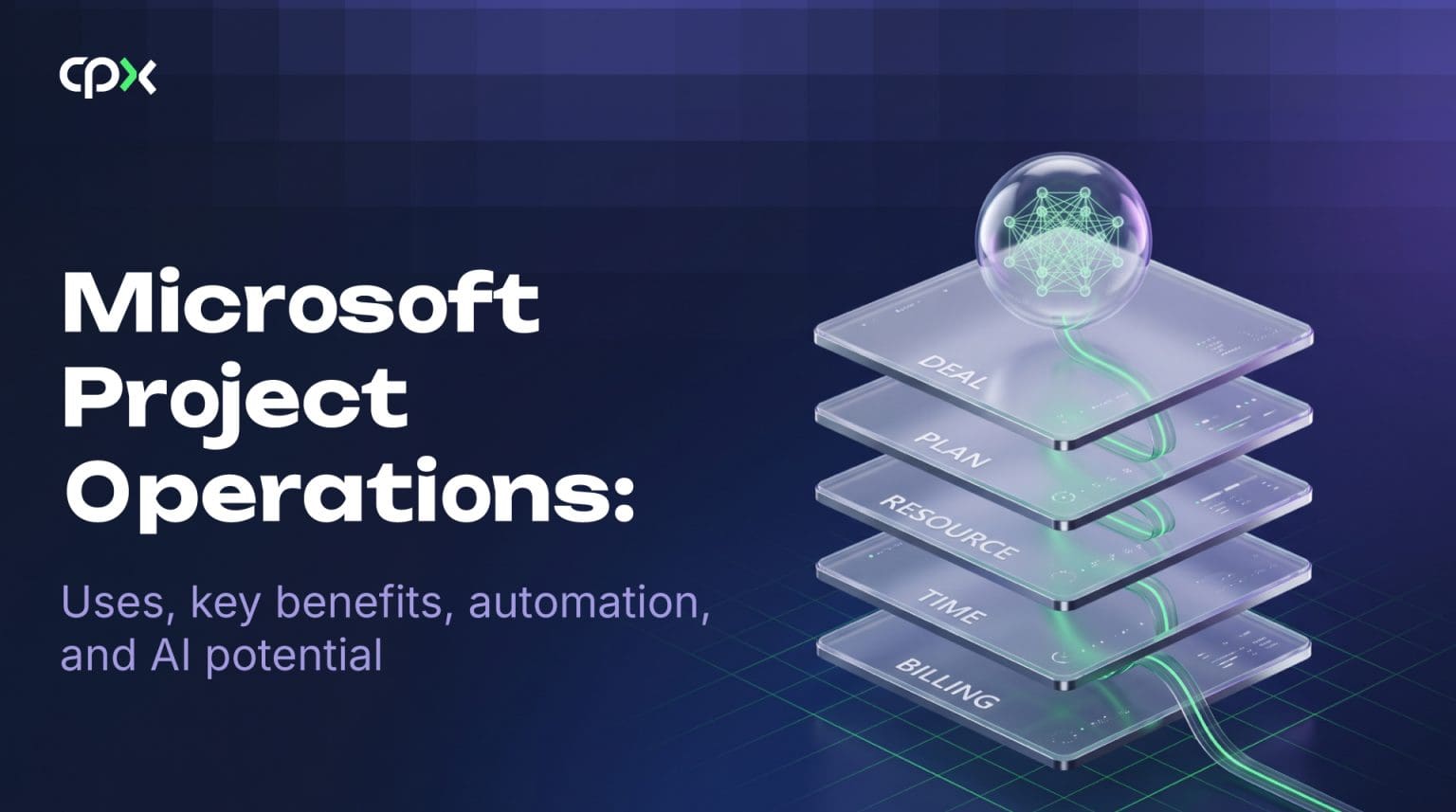
Delivering projects today is about far more than tracking tasks and timelines. Organizations need real-time visibility into resources, financial performance, project risks, and customer commitments—all while reducing manual effort and improving delivery outcomes.
Microsoft Project Operations brings these capabilities together in a single platform by connecting sales, project delivery, finance, resource management, workflow automation, and AI-powered insights. This article explores how organizations can use Microsoft Project Operations to improve efficiency, strengthen governance, and deliver projects more successfully.
How Microsoft Project Operations can be used
- Sales to project handover
- Convert approved opportunities into projects more smoothly.
- Capture scope, pricing, timelines, and resource expectations in one place.
- Reduce information loss during handoff from sales to delivery teams.
- Improve project startup speed and accuracy.
- Support better alignment between customer expectations and delivery plans.
- Project planning and delivery
- Build project plans with tasks, milestones, dependencies, and schedules.
- Assign resources based on skills, availability, and project needs.
- Track actual progress against planned delivery.
- Manage risks, issues, and changes more consistently.
- Improve coordination across project teams and stakeholders.
- Resource management
- View resource capacity across teams and projects.
- Match people to work based on role, competence, and utilization.
- Reduce overbooking and underutilization.
- Forecast future staffing needs more accurately.
- Support better workforce planning and delivery confidence.
- Time, expense, and cost tracking
- Enable team members to enter time and expenses in a structured way.
- Improve visibility into actual effort and project costs.
- Support approvals and compliance processes.
- Reduce manual spreadsheet-based tracking.
- Strengthen data quality for invoicing and financial analysis.
- Billing and financial management
- Link project delivery to contract terms and billing rules.
- Support milestone-based, fixed-price, or time-and-material billing.
- Improve revenue recognition and financial accuracy.
- Reduce delays in invoicing.
- Help leadership monitor project profitability more effectively.
- Reporting and Executive Visibility
- Provide dashboards for project health, costs, margins, and utilization.
- Give management a clearer view of delivery performance.
- Support data-driven decision-making.
- Identify at-risk projects earlier.
- Enable better forecasting and operational planning.
Business benefits of Microsoft Project Operations
- Improved end-to-end visibility
- A single source of truth across sales, delivery, resource management, and finance.
- Better transparency into project status, budgets, actuals, and risks.
- Easier access to real-time information for decision-makers.
- Greater operational efficiency
- Less manual administration across project lifecycle activities.
- Faster handoffs, approvals, updates, and reporting.
- Reduced reliance on disconnected tools and spreadsheets.
- Better resource utilization
- More effective allocation of people to the right work.
- Improved view of capacity and demand.
- Stronger balance between utilization, delivery quality, and employee workload.
- Stronger financial control
- Improved cost tracking and billing accuracy.
- Better understanding of profitability by project, customer, or service line.
- More confidence in forecasting revenue and margins.
- Higher delivery consistency
- Standardized project processes and governance.
- Better monitoring of milestones, risks, and dependencies.
- More predictable outcomes across projects.
- Enhanced collaboration
- Shared data and workflows across business functions.
- Better communication between sales, project teams, resource managers, and finance.
- Reduced duplication of effort and fewer handoff errors.
How workflow automation improves project delivery
One of the most valuable aspects of Microsoft Project Operations is its ability to support workflow automation, especially when combined with Microsoft Power Platform tools like Power Automate.
- Automated approvals
- Route time entries, expenses, budget changes, and project updates automatically.
- Reduce bottlenecks caused by email-based approval processes.
- Improve turnaround times and governance compliance.
- Task and process automation
- Trigger actions when a project is created, approved, or moved to a new stage.
- Automatically notify stakeholders about deadlines, risks, or missing updates.
- Create standard repeatable processes for common project events.
- Sales-to-delivery automation
- Auto-create project records from approved opportunities or contracts.
- Transfer relevant customer, commercial, and scope information into delivery workflows.
- Reduce rekeying effort and manual setup errors.
- Time and expense automation
- Send reminders for missing timesheets or outstanding expense claims.
- Escalate overdue approvals automatically.
- Support faster month-end processing and billing readiness.
- Financial and billing automation
- Generate billing triggers based on milestones, time posted, or contract terms.
- Support automated invoice preparation workflows.
- Improve consistency in financial processing.
- Data integration automation
- Sync project data with finance, CRM, reporting, and collaboration tools.
- Reduce duplicate data entry between systems.
- Improve data consistency across the organization.
- Document automation
- Generate project documents, status reports, and client summaries from system data.
- Standardize templates and outputs.
- Save time on recurring administrative tasks.
- Notification and alert automation
- Trigger alerts for budget overruns, resource conflicts, delayed tasks, or missing approvals
- Help teams respond earlier to delivery and financial issues.
- Improve accountability and responsiveness.
- Governance automation
- Enforce required project setup fields, approvals, and stage gates.
- Support compliance with internal controls and delivery standards.
- Reduce the risk of skipped steps or incomplete records.
How AI enhances Microsoft Project Operations
AI can add even more value to Microsoft Project Operations by improving forecasting, recommendations, and productivity. Depending on the Microsoft capabilities enabled, including Copilot and connected AI services, organizations may gain important advantages.
- Smarter forecasting
- Use historical data to improve predictions around timelines, effort, costs, and margins.
- Highlight trends that may indicate delivery or financial risk.
- Support more proactive planning and decision-making.
- Resource recommendations
- Suggest suitable resources based on skills, availability, and prior project experience.
- Help project managers staff work more effectively.
- Improve utilization while reducing manual planning effort.
- Risk identification
- Detect early indicators of project slippage, cost overruns, or low margin performance.
- Surface exceptions and anomalies faster than manual review alone.
- Enable earlier intervention by project leaders.
The future of project management lies in connected, intelligent operations. By combining project delivery, automation, and AI within a single platform, organizations can move beyond reactive management to proactive decision-making—improving visibility, strengthening collaboration, and delivering better business outcomes.