
Our industry has become very good at finding problems. It is not yet good enough at removing them, and that is where the real work now sits.
The vulnerability remediation gap behind the dashboard
Almost every organization I speak to can tell me how many vulnerabilities it found last quarter. Very few can tell me how many it removed. In my experience, the hard part isn’t finding vulnerabilities. It is identifying which ones actually matter. When everything is a priority, nothing is, and that is why the same vulnerabilities keep coming back, scan after scan.
- The team that finds a vulnerability rarely owns the server, the change window, or the business process behind it, and every handoff adds days. Closing that gap means connecting security findings with the wider Cyber Operations processes needed to act on them. Tickets reach IT teams in bulk, in generic, textbook wording, with no clear recommendation on what to do. A severity score alone doesn’t say what is exploitable or what matters to the business. Automated Vulnerability Remediation helps shift the focus toward exploitable, reachable vulnerabilities and the actions needed to reduce the risk.
- Some systems can’t be patched: legacy and OT platforms that can’t take downtime, and vulnerabilities with no vendor fix yet.
- A ticket marked “resolved” is not an exposure removed. Without a re-test, the same findings turn up in the next penetration test.
- Attackers are getting faster. AI is helping them weaponize new disclosures in hours, while remediation still runs on ticket queues and change windows.
What I have seen is that only around one in ten findings is genuinely critical and needs action now. Much of the rest is already contained by compensating controls. But when it all lands on IT as a pile of tickets with no context, the critical few get lost, and the people expected to fix them feel we are dumping our problem on their desk. I understand that frustration.
Why vulnerability detection without remediation falls short
We have invested thoughtfully in scanners, attack surface management, threat intelligence, penetration testing and security operations, and those investments have served us well. They are the reason we know where the risk is, and they give us a strong foundation to build on.
The next step is to build on that visibility. Finding a vulnerability on its own doesn’t change risk, and neither does scoring or ticketing it. Risk falls when an exposure is fixed or mitigated and someone has confirmed the change worked. Prioritization is essential, but without remediation it can leave us with a better-organized backlog.
As leaders, our job is to give our teams the right prioritization and the right tools, so their time goes to the exposures that matter rather than to triaging noise. That means running remediation as part of cyber operations, like detection and response: named owners, deadlines, automation and evidence. Not a ticket queue competing with everything else in IT.
Reduce exposure first, then fix it properly
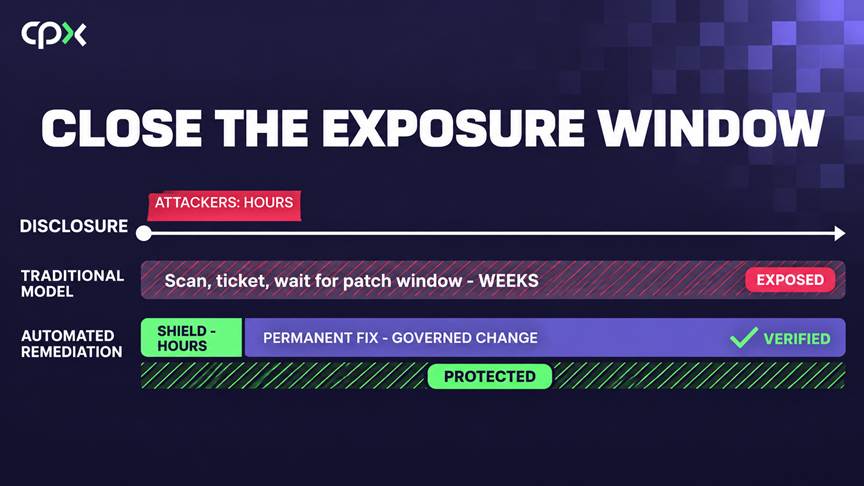
The most useful shift I have seen is separating protection from the permanent fix. Patching in production takes time, and it should; change control exists for good reasons. The real problem is that nothing protects the system while you wait.
Critical security controls can help close that gap. A virtual patch on a web application firewall or intrusion prevention system, or a block on attacker infrastructure the SOC has flagged, can protect an internet-facing system within hours. The permanent patch follows through change control, and a re-test proves it held.
My team spends much of its time running and hardening exactly these devices. Treated as static infrastructure, they are an underused lever. Actively managed, they are the fastest risk-reduction tool most organizations already own.
This is also where automated remediation earns its place. It is broader than automated patching: configuration hardening, virtual patches, rule updates and blocking, followed by automatic verification. Routing a finding to the right owner with a specific recommended action, triggering an approved playbook and re-scanning are mundane steps that automation and AI should take off skilled engineers, so their judgment goes where it is needed.
Automated remediation needs the right guardrails
I am enthusiastic about automation, but not unsupervised automation. Approval gates for higher-risk changes, a full audit trail and rollback are non-negotiable. Application code still needs developers, and fragile OT needs compensating controls rather than automated change. We are building and testing agentic capabilities ourselves, and we follow our own advice: start where the guardrails are strongest and widen the scope as the evidence builds.
Measure cyber risk reduction, not just vulnerabilities
If the job is reducing risk, the scorecard should show reduction. Coverage metrics still matter, but they belong next to outcomes: critical exposures eliminated, high-risk findings closed on time, how often fixed issues return, and how many closures were verified by a re-test.
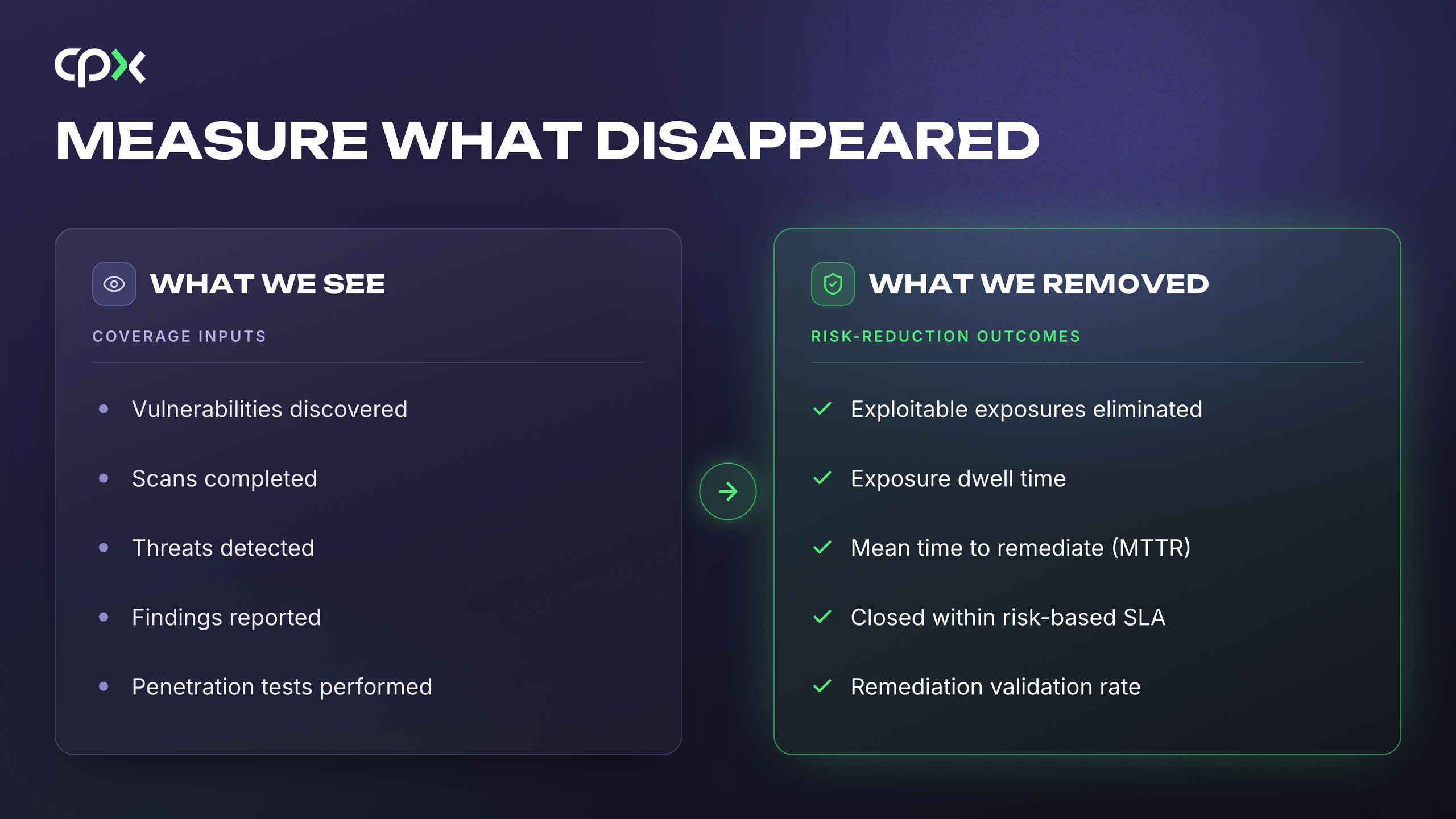
If I could put one number in front of a board, it would be mean time to mitigate. Mean time to remediate tells you how long the fix took; mean time to mitigate tells you how long you were exposed.
Closing the gap with automated vulnerability remediation
We built Automated Vulnerability Remediation, part of CPX Cyber Operations, because we kept seeing this gap. Security operations, threat intelligence, exposure management and penetration testing show where the risk is and contain active threats. We remove the weaknesses behind them. We take findings from your scanners, tests, and SOC and separate the critical few from those already covered by compensating controls. We then give each finding a clear action, shield what is urgent, fix or coordinate the permanent fix through your change process, and re-test every closure.
The simplest place to start is an Exposure Compression Assessment: a baseline of your internet-facing estate showing what is exploitable, how long critical exposures stay open, and what can be shielded straight away.
The cyber risk question leaders should ask
Detection will always matter. But at your next risk review, alongside “What risks have we found?”, ask one more question: “What risk have we actually removed, and how do we know?”
The value of cybersecurity lies not only in how much risk we can see, but in how much risk we can demonstrably remove.