
Cyber incidents rarely become business crises because of technology alone. They escalate when people cannot verify what they see, teams act without a shared process, and leaders lack the context to make timely decisions.
The human factor in cyber readiness
AI-enabled threats are making familiar attacks more convincing. A compromised supplier account can now be paired with realistic phishing messages and a cloned voice message, creating a situation in which an urgent request appears to come from someone employees already trust.
At the same time, security tools may generate a flood of alerts without providing a common understanding of business impact. The challenge is therefore not only detecting malicious activity. It is ensuring that people across the organization can interpret, verify, escalate, and act in a coordinated way.
This is the foundation of human-centric cyber readiness: preparing people before an incident and connecting their actions through clear processes and enabling technology. It treats cyber readiness as an organization-wide capability rather than a responsibility owned solely by the security function.
Readiness prepares; resilience keeps the organization moving
Cyber readiness is what an organization establishes before an incident: clear responsibilities, practical response plans, tested processes, and technology that supports detection and decision-making. Cyber resilience is the ability to respond, adapt, maintain critical operations, and recover when disruption occurs.
The distinction matters. Readiness reduces uncertainty; resilience determines whether the organization can keep moving under pressure. Technology may detect suspicious activity, but people must interpret its significance, understand the operational impact, and decide what happens next.
The real test is whether preparation translates into coordinated action.
Three connected pillars of cyber readiness
A human-centric approach does not reduce the importance of technology. Instead, it aligns three interdependent pillars: people, process, and technology.
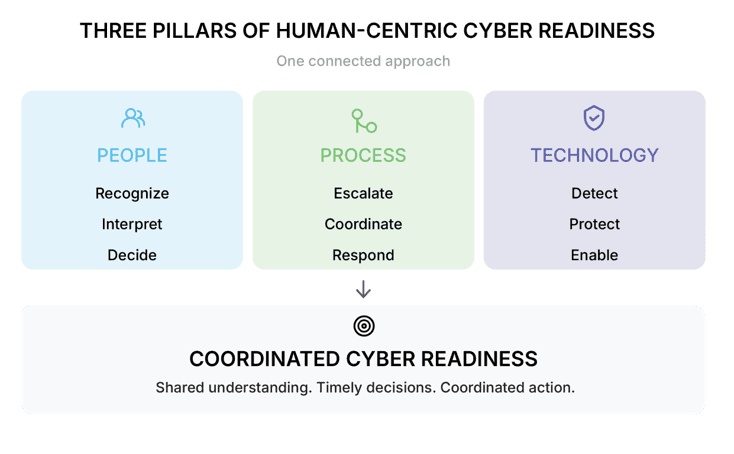
- People provide context, judgment, and ethical oversight. They need the confidence to pause when an instruction appears unusual, verify a request through a trusted channel, and report concerns without delay. In an environment shaped by AI-generated impersonation, these behaviors are increasingly important.
- Process turns individual awareness into a coordinated response. Clear escalation routes, decision authority, and defined ways of working help employees and specialist teams understand what happens after a concern is raised. Processes should also clarify the responsible use of AI, including which tools are approved, what information may be shared, and how AI-related risks should be reported.
- Technology protects systems and supports human decisions by detecting suspicious activity, controlling access, and monitoring how AI and organizational data are used. Yet an alert is only an indication that something requires attention. Without context, ownership, and action, it does not create readiness.
Consider a finance employee who receives an urgent payment instruction that appears to come from a familiar executive. Technology may flag unusual activity, process determines how the request is verified and escalated, and people apply judgment and involve the right decision-makers.
From the frontline to the boardroom
Cyber readiness should reflect the decisions expected of each role. Employees must recognize and report warning signs. Specialists must assess the impact, coordinate the response, and restore operations securely. Leaders must make informed decisions when facts are incomplete, balancing security, continuity, and accountability.
Readiness depends on the handoffs between these groups: employees need clear reporting routes, specialists need the authority and information to act, and leaders need timely insight into business impact.
Build capability through a continuous cycle
Human-centric readiness is not achieved through a one-time awareness campaign. A practical model is to Assess, Train, and Simulate continuously.
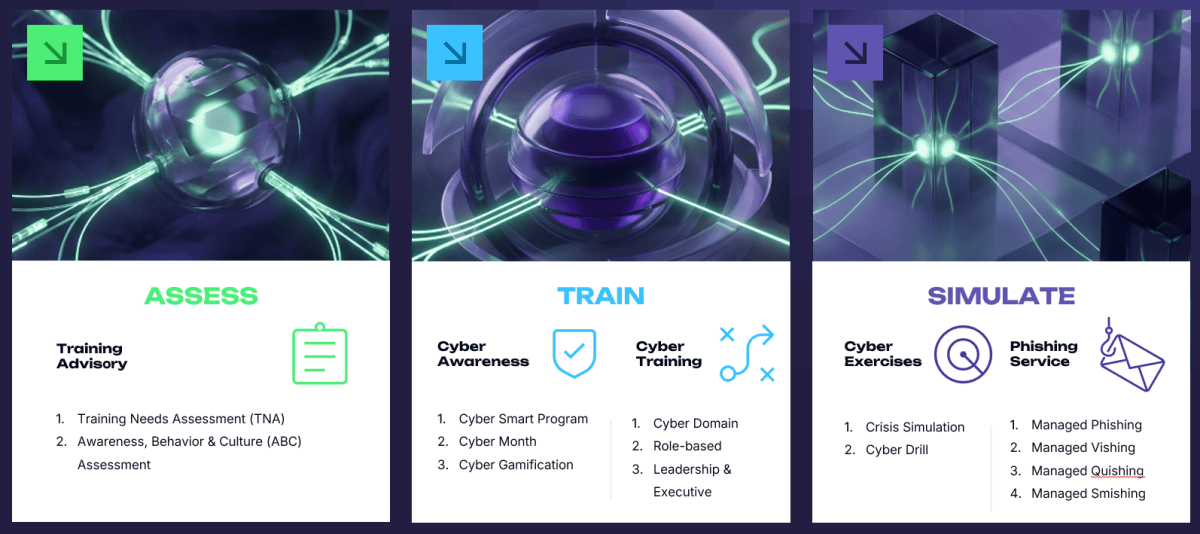
- Assessment establishes a realistic baseline. Training needs assessments and reviews of awareness, behavior and culture can identify strengths, capability gaps and the areas that require priority attention.
- Training then develops the behaviors and expertise appropriate to each role: practical awareness for employees, focused capability development for specialists, and decision-making and crisis oversight for leaders.
- Simulation closes the gap between knowing and doing. Realistic cyber exercises, crisis simulations and human-targeted threat scenarios allow organizations to observe how people respond under pressure.
Do employees verify unusual requests? Can specialist teams build a shared view of impact? Do leaders know when to intervene? The findings should feed back into the next assessment and improvement cycle.
Conclusion: Readiness is coordinated human capability
The most important shift is to stop treating people as the weakest link and start preparing them as an active part of the defense. This does not mean turning every employee into a cybersecurity expert. It means ensuring that each person knows what to recognize, how to respond, and when to escalate.
Technology can identify suspicious activity, but readiness is demonstrated by what happens next: employees pausing to verify, specialist teams coordinating effectively, and leaders making informed decisions under pressure.
The strongest organizations will not be those that eliminate every human error. They will be those that give people the judgment, processes, and support to prevent a single mistake from becoming a business crisis.