
In an era dominated by artificial intelligence (AI), threat intelligence is becoming easier to produce but significantly harder to differentiate.
Automated systems can now effortlessly draft threat reports, enrich indicators, and cluster complex campaigns in a matter of seconds. Yet, despite this unprecedented abundance of data, security operations still struggle to translate raw information into a distinct operational advantage.
The bottleneck we face today is not a scarcity of intelligence; it is the inability of static intelligence alone to deliver a competitive edge. For years, Threat Intelligence has been described as “actionable.” In practice, however, most organizations are left waiting. Security teams watch threat reports accumulate and indicators expire, while agile adversaries continuously outpace traditional intelligence cycles.
In modern cyber defense, however, the defining victory belongs to those who operationalize intelligence with speed and precision. Today, this advantage no longer belongs to those with the most intelligence rather it goes to those who can put it to work.
The strategic flaw in modern threat intelligence
A big part of the problem lies in how most organizations still treat Threat Intelligence as a standalone capability.
Threat Intelligence teams produce insights. Threat Hunting teams investigate activity. Incident Response teams step in during a breach. Detection teams build controls. Each of these roles is incredibly important, but they often operate separately.
Attackers do not see those boundaries. They interact with one environment, test it, learn from it, and adjust. Every failed attempt teaches them something, and every success makes their next attempt easier.
That is where things start to break down. Defenders often operate in parts, while attackers behave as one unified system. For businesses, this creates a fundamental imbalance. The attacker learns as a system, while the defender often responds as a collection of functions. That imbalance is becoming increasingly difficult to sustain. AI is speeding things up on both sides, but without changing how teams work together, technology mostly makes organizations quicker to react, rather than better at staying ahead.
Frans Johansson’s idea of the Medici Effect helps explain why this matters. His argument was simple: real breakthroughs happen when different disciplines come together, not when they stay in their own lanes. The Renaissance did not happen because people worked in isolation. It happened because ideas crossed boundaries.
Cybersecurity is now running into the same challenge. Individually, each security discipline creates value. But when they are brought together into a shared ecosystem, they create something far more powerful: Adaptive Intelligence. At their intersection, intelligence becomes testable, hunting becomes strategic, and response becomes a continuous learning mechanism. This is where defensive advantage truly emerges, directly linking security agility to measurable business resilience.
Figure: The Adaptive Intelligence Ecosystem
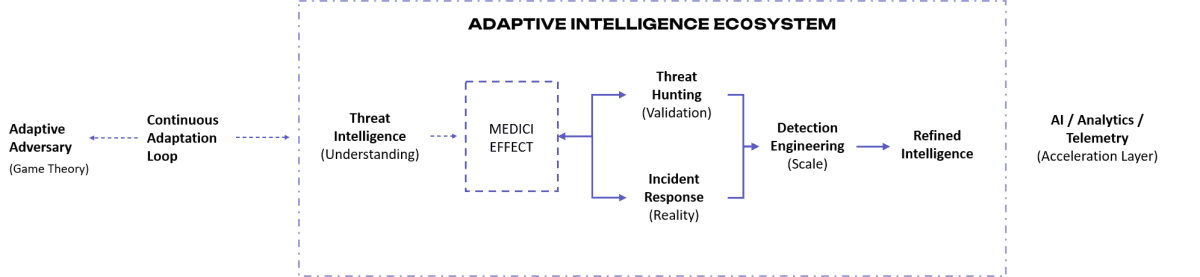
The central Medici Effect intersection represents the convergence of Threat Intelligence, Threat Hunting, Incident Response, and Detection Engineering, where operational innovation emerges. Surrounding the ecosystem is a continuous Game Theory dynamic in which defenders and adversaries constantly adapt to one another. AI acts as an acceleration layer, increasing the speed of learning, validation, and operationalization across the system.
Where intelligence becomes useful
Each function in security sees a different part of the picture. Threat Intelligence focuses on the adversary. Threat Hunting looks at how those threats might actually show up internally. Incident Response handles what really happens during an attack. Detection Engineering focuses on what can be picked up consistently across systems.
On their own, these perspectives are useful. But when they come together, they reinforce each other. Intelligence gets tested on the ground, assumptions get challenged, and insights get refined. Security stops being theoretical and starts becoming practical.
For instance, you can see this clearly in a ransomware scenario. Intelligence might point to a specific pattern, like credential theft followed by lateral movement across systems. On its own, that is just insight. When a hunting team looks into it, it becomes an active inquiry: are we seeing anything like this in our environment? If they find something, incident response can confirm exactly how the attack played out, showing how access was gained, what was touched, and how the attacker stayed hidden.
Those real-world learnings then feed directly back to detection engineers, who build custom alerts to spot similar behavior going forward. At that point, threat data is no longer just information. It becomes a permanent part of how the organization protects itself.
AI can automate the data but security teams must still drive the decisions
AI is making it much faster to generate intelligence. Tasks that used to take time, like enrichment, correlation, or summarization, are now largely automated. While that is a good thing, it also shifts where the real value sits. If everyone can produce intelligence quickly, then the intelligence itself stops being the differentiator. What becomes harder, and far more valuable, is knowing what to do with it.
AI can surface patterns and insights, but it does not replace human judgment. It does not understand the unique context of a specific business environment, and it cannot always tell the difference between something that truly matters and something that just looks interesting. That crucial distinction only becomes clear when intelligence is tested against what is actually happening on the ground.
While AI can accelerate enrichment, correlation and analysis, capabilities such as adversarial reasoning, strategic judgment, contextual interpretation, hypothesis-driven investigation and operational intuition remain difficult to automate. These strengths emerge when intelligence, hunting, response and engineering work together.
More intelligence isn’t the answer, better integration is
For security leaders, this shift changes everything.
The challenge isn’t acquiring more intelligence but ensuring that intelligence actually drives decisions and actions. That means connecting teams more closely, building continuous feedback loops, and learning from live incidents instead of just documenting them after the fact.
The cybersecurity industry frequently speaks about actionable intelligence, yet it remains difficult to achieve in practice. Truly actionable intelligence requires context, validation, timely execution and the ability to translate findings into effective controls. These conditions rarely emerge through threat intelligence alone and are more likely to develop when intelligence, hunting, response and detection disciplines operate as an integrated system.
Organizations that continue to optimize security functions in silos will struggle to keep up. Those that actively connect them will adapt faster, turning everyday operational reality into a shared learning loop of continuous improvement and operational continuity.
The real advantage lies in a blind spot
AI is rewriting the security playbook, but the real disruption isn’t where people are looking.
In cybersecurity, the advantage always goes to the side that learns faster. While AI is making intelligence more available than ever, raw availability is no longer the bottleneck. The real challenge lies in turning that intelligence into environment-specific, operational defense. The future is not about who accumulates more data; it is about how seamlessly that intelligence is fused, tested, and improved in real time. For security leaders, the real benchmark is whether their intelligence is agile enough to survive, adapt and dominate in operational reality, ultimately securing the business against an unpredictable future.