

06 March, 2026
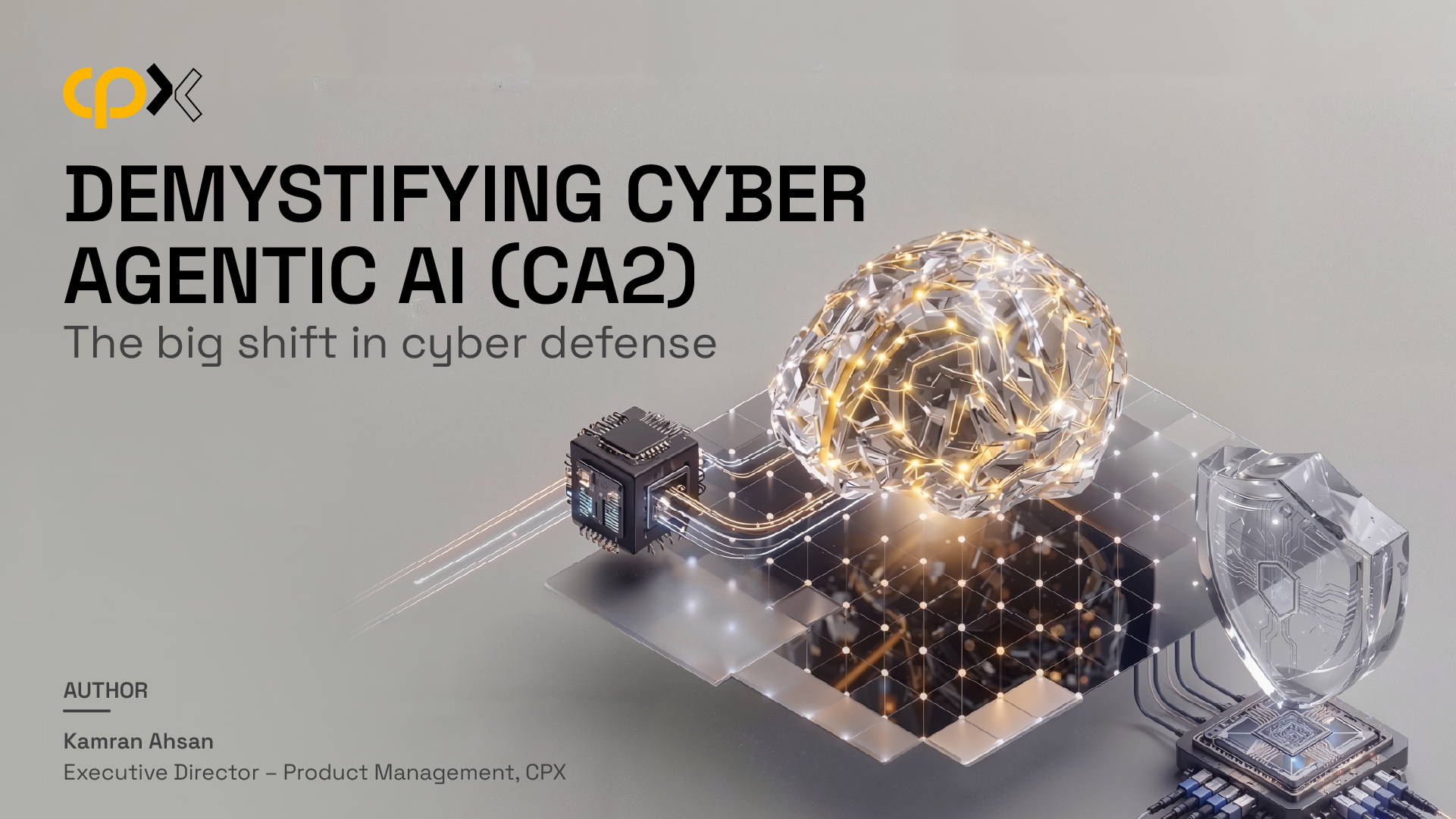
Agentic AI has quickly become one of the most discussed ideas in cybersecurity, yet it remains one of the least understood. Many leaders hear the term and assume it’s simply “AI but faster” or “AI with automation.”
In reality, Cyber Agentic AI (CA2) represents a fundamental shift in how cyber defense systems think, decide, and act.
In this article, we demystify Cyber Agentic AI (CA2) – how agentic AI works in a cyber defense context, and what it means for the next era of AI-native cyber resilience.
For years, cybersecurity AI has been largely analytical — classifying anomalies, scoring risks, or recommending actions. Useful, yes. Transformational, no.
Cyber Agentic AI (CA2) changes the paradigm.
Instead of simply advising humans, CA2 systems are designed to act autonomously toward defined security outcomes.
In a cyber defense context, CA2 systems are:
CA2 behaves less like a dashboard and more like a digital analyst—or, in advanced cases, a digital responder.
This is the difference between AI that advises and AI that executes.
This is what autonomous cyber defense looks like in practice:
To make this real, imagine an AI system that can:
This is the emerging standard for AI‑native cyber defense.
CA2 doesn’t replace analysts. It removes the repetitive, time‑consuming work that prevents them from focusing on strategy, threat hunting, and complex decision‑making.
Three forces are converging:
The result is a widening gap between threat velocity and defensive capacity. CA2 closes that gap by introducing machine‑speed defense.
This is not about doing the same work faster. It’s about changing the nature of the work entirely.
At CPX, we view CA2 as the foundation for the next generation of cybersecurity offerings. It aligns directly with our mission to deliver AI‑native, sovereign, and scalable cyber resilience for the UAE and the region.
Across our portfolio, agentic capabilities are already emerging:
At CPX, we see CA2 as a core building block of AI-native, sovereign cyber resilience services, from SCO operations to national-scale platforms.
If you need a single, practical definition to guide your strategy:
Cyber Agentic AI (CA2) is the ability of AI systems to independently monitor, reason, and act across digital environments to achieve defined security outcomes—safely, autonomously, and at scale.
This is the foundation upon which the next decade of cyber resilience will be built.

25 February, 2026
Identity and Access Management in the age of AI and autonomous ag...
Read now
05 February, 2026
From Reactive to Autonomous: The rise of Agentic AI in cybersecurity
Read now
03 February, 2026
Risk prioritization in today’s evolving cyber threat landscape
Read now
14 January, 2026
Cybersecurity in 2026: Why identity, AI, and trust will define th...
Read now
21 November, 2025
Red Teaming vs. VAPT: Choosing the right test for stronger cyber ...
Read now
13 November, 2025
Compliance isn’t security: The hidden risks of a checkbox approach
Read now
29 October, 2025
GraphQL Abuse: The silent killer in API security
Read now
22 October, 2025
Securing DevOps: A GRC perspective on agility, assurance and secu...
Read now
08 October, 2025
How SOCaaS can power transformation and foster innovation in GCC
Read now
26 September, 2025
Why is red teaming a must for OT systems
Read now

19 September, 2025
UAE cybercrime statistics 2025: Key data and trends
Read now

17 September, 2025
Cyber Risk Management: Qualitative vs. Quantitative Approaches
Read now
10 September, 2025
Why AI-powered SOCs are the future of cyber defense
Read now
03 September, 2025
How AI is transforming cybersecurity and threat detection
Read now
29 August, 2025
AI vs Hackers: Who is winning the cybersecurity arms race
Read now
28 August, 2025
Why every cybersecurity team needs document version control
Read now
27 August, 2025
AI agents in cybersecurity: Your new virtual SOC team
Read now
21 August, 2025
Securing Operational Technology: Challenges and best practices
Read now
17 July, 2025
Red Teaming in cybersecurity: Why thinking like a hacker matters
Read now

21 May, 2025
What is a SCIF? Inside the CPX Secure Compartmented Information F...
Read now
21 April, 2025
Cybersecurity in the UAE: What CISOs must prioritize today
Read now
18 March, 2025
The critical role of trusted advisors in OT cybersecurity
Read now
14 February, 2025
AI Agents: The new arsenal CISOs need
Read now
27 January, 2025
Make your AI work right: A framework for secure and ethical AI
Read now
14 January, 2025
Revolutionizing SOC efficiency: The power of cyber-physical integ...
Read now

20 November, 2024
The Modern CISO Playbook: Top priorities for CISOs in 2025
Read now
30 August, 2024
Ask the Right Questions to Get Data Privacy Compliance Right
Read now
29 December, 2023
Navigating Cyberspace in 2024: A Sneak Peek into the Top Security...
Read now
14 December, 2023
Top systems integration challenges every organization must prepar...
Read now
29 August, 2023
Help ! My Facebook has been hacked
Read now

20 July, 2023
Security Product Research in the Lab: A fair chance to prove your...
Read now

20 July, 2023
The Cyber Security Conundrum: Balancing Ego and Expertise
Read now

20 July, 2023
The Internet Never Forgets
Read now
20 July, 2023
Top Cloud Security Risks and How to Address Them
Read now

20 July, 2023
Why Continuous Education, Training and Awareness are Essential fo...
Read now
02 May, 2023
A 5-Star Partner: Priming Your IT and Security Services for Success.
Read now

02 May, 2023
AI and Cybersecurity: A Tale of Innovation and Protection
Read now

02 May, 2023
How to Select a Secure Cloud Model, One Size Does Not Fit All
Read now

02 May, 2023
Making Sense of Public Ratings in Product Selection Process
Read now

02 May, 2023
Privacy Compliance: A Four-Step Approach
Read now

02 May, 2023
Securing Your Website – Gaining Online Customers’ Trust
Read now
©CPX 2026. All rights reserved. Privacy policy | Terms of use