

03 February, 2026
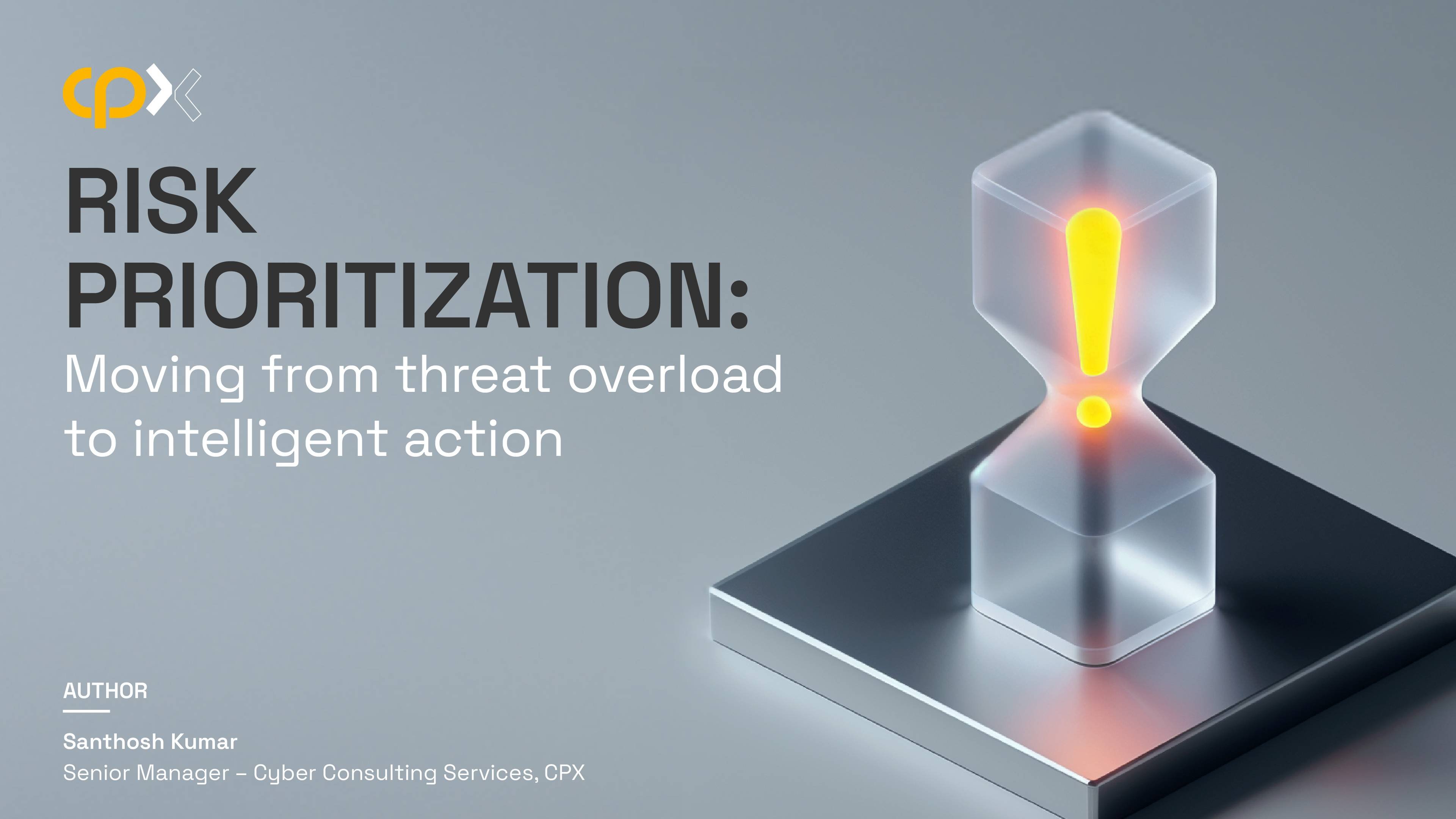
In today’s hyperconnected world, every innovation, from cloud adoption and artificial intelligence to the proliferation of IoT and remote work, expands not only opportunities but also vulnerabilities. As organizations accelerate digital transformation, the traditional boundaries that once protected enterprise systems are dissolving, giving rise to a broader, more complex cyber threat landscape.
This has resulted in an increase in cyber threats and the associated cyber threat intelligence (CTI) being generated for organizations’ consumption. CTI contains information about threats and threat actors that help mitigate against malicious activity. Therefore, it is in the organization’s best interest to consider integrating CTI with the risk management process to enable the organization to take corrective actions based on risk prioritization.
There are several practical challenges with this integration process because of the time-sensitive nature of the emerging threats. These challenges warrant a discussion around a more suitable approach under unprecedented circumstances when it comes to rethinking risk prioritization.
Organizations use CTI information to mitigate any relevant vulnerabilities within their business environment prior to these being identified and targeted by threat actors.
CTI team should first identify any corresponding vulnerabilities within the business environment against the nature of the increased cyber threats. Then, the CTI team should inform the corresponding stakeholders (mostly Information Technology and Cybersecurity teams) to fix these vulnerabilities. However, organizations do not have unlimited resources or bandwidth and require some prioritization to fix those cyber threats that are critical and require immediate action.
Organizations might already be using a risk-based prioritization for the cyber threats arising out of CTI. A risk-based approach to cybersecurity means that risk is above all other factors before making security-related decisions. This approach without considering the time-sensitive nature of these threats would not be very effective. Moreover, a risk-based prioritization with a time-sensitive approach would enable organizations to take risk-aware decisions in a timely manner.
This risk prioritization should be implemented by integrating the threats arising from CTI into the cybersecurity risk management process. The cybersecurity risk management team should calculate the risk ratings (e.g., High, Medium and Low) for these threats based on their risk management framework (impact and likelihood statements). Refer to the matrix below for a sample risk prioritization matrix. Then, the cybersecurity risk management team should provide risk-based prioritization for these threats to the corresponding stakeholders. Finally, the stakeholders should take corrective action based on these risk ratings and their associated timelines. A risk-based approach to CTI would ensure effective prioritization of cyber threats and their corresponding mitigation efforts.
|
Risk Rating |
|||
|
|
Impact |
||
|
Likelihood |
Low |
Medium |
High |
|
High |
Low |
Medium |
High |
|
Medium |
Low |
Medium |
Medium |
|
Low |
Low |
Low |
Low |
Figure 1: Sample Risk Prioritization Matrix
However, there are several practical challenges while using a risk-based approach to prioritizing CTI. These are mainly due to the time-sensitive nature of these threats. Stakeholders need to take immediate action to mitigate these real-world threats, as threat actors (attackers) are continuously exploiting them.
However, the risk prioritization might unintentionally delay the process of corrective action, as a regular cybersecurity risk assessment should be performed for these threats. Hence, the stakeholders might need to wait until the issuance of the complete risk assessment report to initiate corrective actions. This unintentional delay could be considered critical and even unacceptable, given the time-sensitive nature of these threats.
These challenges are elaborated below:
Though these challenges might appear daunting at first look, diligent evaluation of existing processes could provide some valuable solutions. There is no perfect solution for these practical challenges. However, some delicate changes to existing processes could result in an optimal and feasible solution. They are:
With organizations receiving increased CTI about cyberattacks and the associated threats, it will require a method of prioritization for taking corrective actions.
Refer to State of the UAE Cybersecurity Report 2025 for the latest cyber threat intelligence. The current situation provides compelling reasons to review and enhance the integration of CTI with the cybersecurity risk management process with specific consideration given to the time-sensitive nature of these cyber threats. The above recommendations will be a great start for this enhanced integration process. Organizations can also speak with an external Governance, Risk and Compliance (GRC) consultant to manage this enhanced integration process.

10 March, 2026
vCISO vs. Advisory CISO: How to choose the right Trusted Cybersec...
Read now
06 March, 2026
The Big Shift: Demystifying Cyber Agentic AI (CA2)
Read now
25 February, 2026
Identity and Access Management in the age of AI and autonomous ag...
Read now
05 February, 2026
From Reactive to Autonomous: The rise of Agentic AI in cybersecurity
Read now
14 January, 2026
Cybersecurity in 2026: Why identity, AI, and trust will define th...
Read now
21 November, 2025
Red Teaming vs. VAPT: Choosing the right test for stronger cyber ...
Read now
13 November, 2025
Compliance isn’t security: The hidden risks of a checkbox approach
Read now
29 October, 2025
GraphQL Abuse: The silent killer in API security
Read now
22 October, 2025
Securing DevOps: A GRC perspective on agility, assurance and secu...
Read now
08 October, 2025
How SOCaaS can power transformation and foster innovation in GCC
Read now
26 September, 2025
Why is red teaming a must for OT systems
Read now

19 September, 2025
UAE cybercrime statistics 2025: Key data and trends
Read now

17 September, 2025
Cyber Risk Management: Qualitative vs. Quantitative Approaches
Read now
10 September, 2025
Why AI-powered SOCs are the future of cyber defense
Read now
03 September, 2025
How AI is transforming cybersecurity and threat detection
Read now

29 August, 2025
AI vs Hackers: Who is winning the cybersecurity arms race
Read now

28 August, 2025
Why every cybersecurity team needs document version control
Read now
27 August, 2025
AI agents in cybersecurity: Your new virtual SOC team
Read now

21 August, 2025
Securing Operational Technology: Challenges and best practices
Read now
17 July, 2025
Red Teaming in cybersecurity: Why thinking like a hacker matters
Read now

21 May, 2025
What is a SCIF? Inside the CPX Secure Compartmented Information F...
Read now
21 April, 2025
Cybersecurity in the UAE: What CISOs must prioritize today
Read now
18 March, 2025
The critical role of trusted advisors in OT cybersecurity
Read now
14 February, 2025
AI Agents: The new arsenal CISOs need
Read now
27 January, 2025
Make your AI work right: A framework for secure and ethical AI
Read now
14 January, 2025
Revolutionizing SOC efficiency: The power of cyber-physical integ...
Read now

20 November, 2024
The Modern CISO Playbook: Top priorities for CISOs in 2025
Read now
30 August, 2024
Ask the Right Questions to Get Data Privacy Compliance Right
Read now
29 December, 2023
Navigating Cyberspace in 2024: A Sneak Peek into the Top Security...
Read now
14 December, 2023
Top systems integration challenges every organization must prepar...
Read now
29 August, 2023
Help ! My Facebook has been hacked
Read now

20 July, 2023
Security Product Research in the Lab: A fair chance to prove your...
Read now

20 July, 2023
The Cyber Security Conundrum: Balancing Ego and Expertise
Read now

20 July, 2023
The Internet Never Forgets
Read now

20 July, 2023
Top Cloud Security Risks and How to Address Them
Read now

20 July, 2023
Why Continuous Education, Training and Awareness are Essential fo...
Read now
02 May, 2023
A 5-Star Partner: Priming Your IT and Security Services for Success.
Read now

02 May, 2023
AI and Cybersecurity: A Tale of Innovation and Protection
Read now

02 May, 2023
How to Select a Secure Cloud Model, One Size Does Not Fit All
Read now

02 May, 2023
Making Sense of Public Ratings in Product Selection Process
Read now

02 May, 2023
Privacy Compliance: A Four-Step Approach
Read now

02 May, 2023
Securing Your Website – Gaining Online Customers’ Trust
Read now
©CPX 2026. All rights reserved. Privacy policy | Terms of use