

10 February, 2026
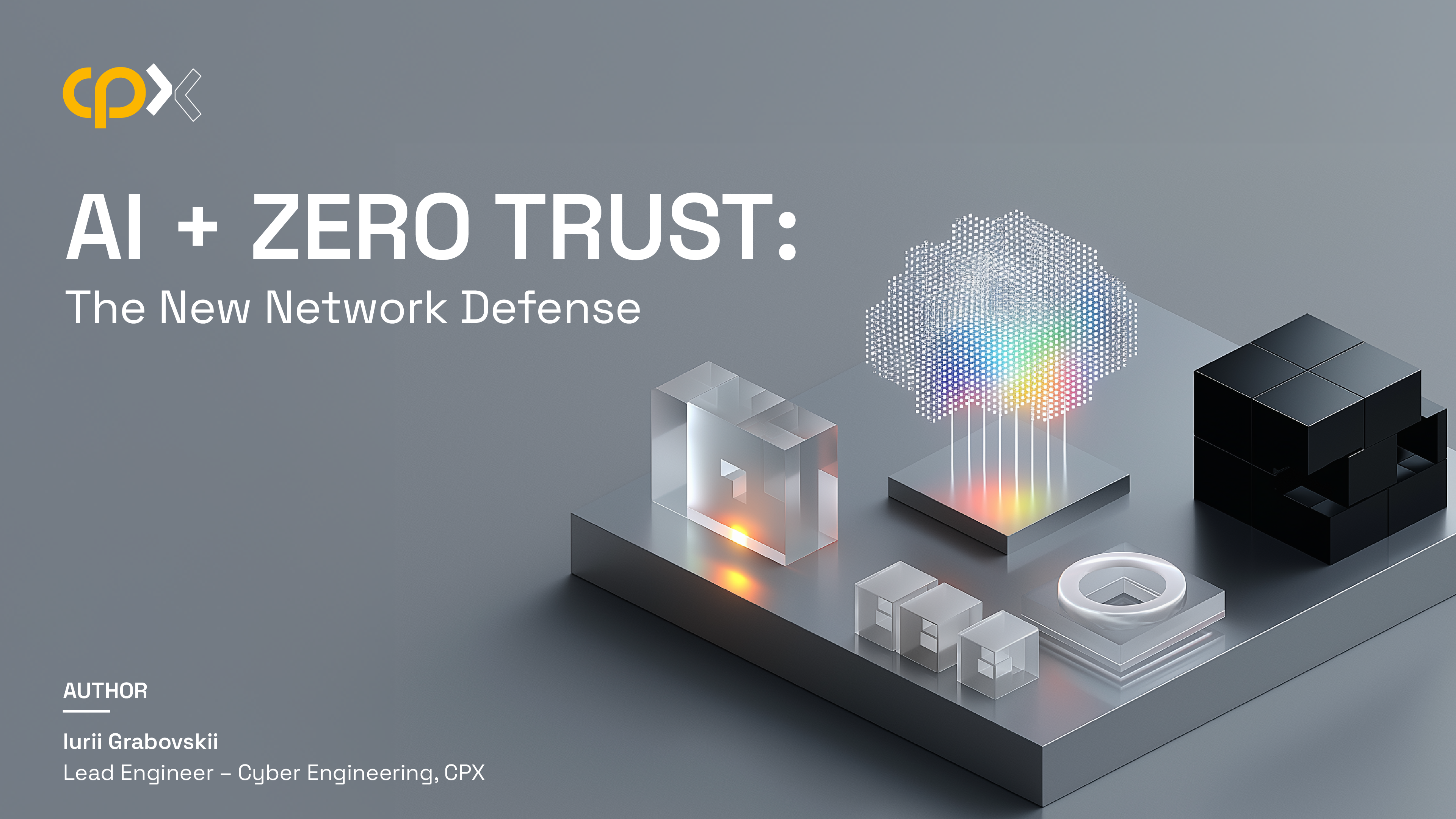
Zero Trust Architecture (ZTA) has become the defining model for modern cybersecurity as organizations navigate hybrid work, cloud expansion, legacy infrastructure, and increasingly sophisticated threats. While Zero Trust provides the right principles — “never trust, always verify” — implementing it consistently across dynamic environments remains challenging.
This is where artificial intelligence (AI) becomes transformative. AI strengthens, scales, and operationalizes Zero Trust, turning it from a static framework into a living, adaptive security posture.
Zero Trust eliminates implicit trust from networks. Every user, device, application, and workload is treated as potentially compromised until continuously verified.
According to NIST SP 800 207 and other leading frameworks, ZTA rests on three foundational principles:
On the other hand, Gartner emphasizes that Zero Trust is not a product but a paradigm shift. It requires replacing implicit trust with continuously assessed context-aware decisions that adapt to risk.
Successful ZTA implementations align with business priorities and follow four core tenets:
Applied to network security, these principles and tenets translate into microsegmentation to limit lateral movement, continuous monitoring of traffic and device posture, and dynamic policy discovery and enforcement at every access point. With hybrid work, cloud adoption, and dissolving perimeters, ZTA has become the most relevant model for modern network defense.
Zero Trust provides the guiding principles, but on its own it can be difficult to enforce consistently across today’s sprawling, hybrid networks. This is where artificial intelligence becomes essential. AI doesn’t just enhance Zero Trust, it powers it, turning static policies into a living system that can adapt in real time. By analyzing vast amounts of telemetry, learning normal patterns of behavior, and responding instantly to anomalies, AI makes it possible to apply Zero Trust at enterprise scale and speed.
The impact of AI can be seen across several critical areas of Zero Trust implementation — from continuous verification and microsegmentation to anomaly detection, automated containment, and even encrypted traffic analysis. Each of the following areas illustrates how AI transforms Zero Trust from a framework into an operational reality.
The integration of AI into Zero Trust Architecture does more than streamline operations, it fundamentally changes the speed, scale, and effectiveness of network defense. Traditional security models often struggle to keep pace with the volume of data and the sophistication of modern attacks. By contrast, AI-driven ZTA introduces a level of automation and adaptability that allows organizations to stay ahead of threats rather than simply react to them.
The concepts of AI‑driven Zero Trust are no longer just theoretical. A growing number of vendors have already embedded machine learning and automation into their platforms, offering practical tools that enterprises can deploy today. These solutions vary in focus — some emphasize secure access and continuous verification, others specialize in microsegmentation, anomaly detection, or encrypted traffic analysis — but together they illustrate how AI is reshaping the Zero Trust landscape. The table below highlights several leading examples and the specific capabilities they bring to network security.
|
Vendor/Product |
AI Capabilities |
ZTA Functions Delivered |
|
Zscaler Zero Trust Exchange |
Inline AI/ML traffic inspection, anomaly detection, adaptive access control |
Application discovery, continuous verification, least privilege enforcement, secure access to apps |
|
Arista AI‑driven NDR & Cognitive NAC |
Behavioral analytics, microsegmentation orchestration, and autonomous response |
Application discovery, network segmentation, admission control, and early threat detection |
|
Darktrace DETECT + RESPOND |
Self‑learning AI for network behavior modelling, autonomous mitigation |
Application discovery, anomaly detection, automated policy enforcement |
|
Illumio Core |
AI-assisted application dependency mapping, segmentation policy recommendations |
Application discovery, microsegmentation, lateral movement prevention |
|
Cisco Secure Network Analytics (Stealthwatch) |
AI‑based flow analysis, encrypted traffic analytics |
Threat detection without decryption, network visibility |
While AI greatly strengthens Zero Trust, its integration also introduces new layers of complexity. Organizations must balance the promise of automation and intelligence with the realities of data quality, regulatory compliance, and evolving adversarial tactics. The following challenges highlight the practical hurdles that security teams face when bringing AI into a Zero Trust environment.
Addressing these challenges requires a thoughtful approach, which is why best practices for AI-enabled Zero Trust are essential to guide effective adoption.
Successfully integrating AI into a Zero Trust model is not just about deploying advanced tools; it requires a disciplined, methodical approach that ensures the network remains secure, resilient, and compliant. The following practices provide a roadmap for organizations seeking to maximize the benefits of AI‑driven Zero Trust while minimizing risks.
The future of AI-driven Zero Trust Architecture is set to be even more dynamic and autonomous than what we see today. As networks become more distributed and attackers more sophisticated, AI will evolve from being a supportive tool to becoming the central orchestrator of security ecosystems. One of the most anticipated developments is the rise of self-healing networks. Instead of simply detecting and containing threats, these systems will be able to remediate them automatically, isolating compromised assets, rolling back malicious changes, and restoring services without waiting for human intervention. This shift will dramatically reduce downtime and strengthen resilience during large-scale incidents.
Another promising direction is the use of federated learning for threat models. Since privacy and compliance laws often restrict the sharing of raw data across borders, federated learning allows AI models to be trained collaboratively on distributed datasets without moving the data itself. This approach could enable organizations to benefit from global threat intelligence while still respecting local data sovereignty.
The looming challenge of quantum computing is pushing the industry toward quantum resilient Zero Trust. AI will play a critical role in helping organizations transition to post quantum cryptography, continuously validating the effectiveness of new algorithms against emerging risks.
Microsegmentation will become more adaptive. Instead of relying on static or manually tuned policies, AI will continuously refine network boundaries in response to shifting workloads, user behavior, and threat intelligence. This will make lateral movement by attackers far more difficult.
Deception technologies are also expected to advance, with AI deploying and adapting decoys in real time to confuse adversaries and buy defenders valuable time.
Finally, AI will increasingly act as the connective tissue across security domains, correlating signals from endpoints, networks, identities, and cloud workloads. This cross-domain visibility will allow organizations to detect complex, multi vector attacks more quickly and respond with greater precision.
Taken together, these developments point toward a future where Zero Trust is no longer a static framework but a living, adaptive defense system. AI will make it predictive, autonomous, and resilient by design. The real challenge for organizations will not be whether these technologies exist, but how quickly they can be integrated responsibly — balancing innovation with transparency, compliance, and trust.
AI is transforming Zero Trust from a static framework into a living, adaptive defense system. It enables real-time verification, intelligent segmentation, and automated containment — capabilities that are essential in countering today’s AI-powered threats.
The technology is already here, with platforms from Zscaler, Arista, Darktrace, Illumio, and Cisco proving that AI-driven ZTA is not a future vision but a present-day reality. The real challenge for organizations now is not whether to adopt the technologies, but how quickly they can integrate them responsibly, balancing innovation with transparency, compliance, and trust.


23 March, 2026
Cyber resilience in an era of conflict: Why GCC organizations mus...
Read now
18 March, 2026
Crisis-driven Cyber Resilience: Why SOC and Threat Hunting are Mi...
Read now
09 March, 2026
Identity as the target: Resurgence of Microsoft 365 credential ha...
Read now
07 March, 2026
Evolving cyber threat landscape amid Middle East tensions
Read now
27 February, 2026
Moltbook: The rise of agent native AI and a new class of threats
Read now
20 February, 2026
Uncovering the Chinese APT Group .Net Malware Payload – Part 2
Read now

19 February, 2026
Uncovering the Chinese APT Group .Net Malware Payload – Part 1
Read now
12 February, 2026
Enabling visibility and monitoring for ICS networks: Fortifying c...
Read now

10 February, 2026
How to secure your Microsoft Exchange Hybrid Environment for 2026
Read now
14 January, 2026
Ivanti Connect Secure Forensics (Part 3): Integrity Checker Tool ...
Read now
13 January, 2026
Ivanti Connect Secure Forensics (Part 2): GRUB-based LUKS Decrypt...
Read now
09 January, 2026
Ivanti Connect Secure Incident Response Investigation: From explo...
Read now
26 December, 2025
Zero Trust Architecture: Principles, challenges, and best practices
Read now
08 December, 2025
AI-powered OT cybersecurity: Securing critical infrastructure
Read now
08 December, 2025
AI agents are scaling operations — is risk management ready?
Read now
20 November, 2025
Unmasking a Modern Cyber Assault: Lessons from the Anthropic attack
Read now
02 October, 2025
Filtering the noise: A smarter approach to SCADA security
Read now

18 August, 2025
Detection Engineering Validation: Proven detections for modern SOCs
Read now
30 June, 2025
AI-driven cyber attacks: The rising threat in cybersecurity
Read now

29 May, 2025
How AI copilots in cybersecurity are redefining threat intelligence
Read now
10 April, 2025
Strengthening Azure DevSecOps: Closing gaps with third-party enha...
Read now
28 March, 2025
Oracle Cloud incident: Analyzing the breach and its impact
Read now
08 March, 2024
Enhancing physical security through CPS integration
Read now

20 July, 2023
Understanding Insecure Deserialization
Read now
©CPX 2026. All rights reserved. Privacy policy | Terms of use