

03 March, 2026
Geopolitical tensions invariably influence cyberspace, leading to an evolution in the threat landscape. The current escalation in the Middle East, which began on February 28, 2026, is anticipated to follow this pattern across the UAE. Historically, threat actors have exploited such periods to amplify influence operations, conduct opportunistic intrusion attempts, and circulate disinformation narratives.
CPX Threat Intelligence Centre actively monitoring the evolving geopolitical situation and its wider cyber implications across the region, noting an increase in hacktivist activities and targeted disruptions across allied Gulf states.
CPX Threat Intelligence Centre (CPX-TIC) assesses that the current regional geopolitical environment has resulted in an elevated cyber threat posture for the UAE, consistent with historical patterns observed during periods of heightened tension involving Iran and its regional proxies.
Historically, Iranian state‑aligned cyber units have escalated cyber activity in parallel with kinetic or political developments, leveraging a mix of state APT operations and proxy actors. Below are some key plausible activities that can be seen during this ongoing conflict.
In last 24 hours, CPX-TIC has observed a spike in cyber operations by pro-Iranian hacktivist personas and collectives, noting multiple claimed DDoS attacks on entities in UAE, Israel, Saudi Arabia, Kuwait, and Bahrain, followed by alleged SCADA & PLC compromises of Israel-based entities.
Below is the timeline of the cyber escalation from 28-February to 02-March 2026:
|
Cyber Escalations |
28-February-2026 |
|
|
| Threat actor | Origin | Motivation | Recent activity |
| Handala Hack Team | Iran | Ideological, Anti-Israel/ US |
The group announced the imminent start of massive cyber-attacks with no restrictions against regional traitors, urging them to prepare for the destruction of their infrastructure. The group has posted accused the UAE of serious betrayal, threatening to regress the Emirates to a pre-prosperity era of camel-riding and advising Europeans to avoid traveling there for the next 12 hours. The group claim to destruct infrastructures of Jordan gas stations across the country, preventing any vehicles from refuelling. This action was framed as retaliation for what the group described as the Jordanian rulers' "clear betrayal of the resistance," referring to Jordan's perceived alignment with Israel and the US amid the escalation. |
| Fatimion Cyber Team | Unknown | Ideological, Anti-Israel/ Zionist | The group claimed to have compromised the UAE based Government NGO’s website. |
| DieNet | Unknown | Ideological, Anti-Western/Pro-Middle Eastern |
DieNet published DDoS claims against UAE-based government entities (Government Enabled Services, Telecom). |
| Sylhet Gang-SG | Bangladesh | Religious, Political |
Sylhet Gang amplified the DieNet messaging related to UAE targets and issued a broader call for hacker teams from multiple countries to launch collective cyber operations against America and Israel. By combining endorsement of UAE‑related claims with coalition messaging, Sylhet increased the perceived scale of activity and likelihood of copycat participation directed at UAE government portals and adjacent public services. |
| Cyber Islamic Resistance | Unknown | Religious, Political, Pro-Iran, Pro‑Palestinian |
The group announced general mobilization and the establishment of an “Electronic Operations Room”, calling for hackers and cyber‑warfare experts to participate via the group’s official account. Subsequent posts stated that additional teams were joining the operations room, including Cyb3rDrag0nzz and RipperSec. |
|
Cyber Escalations |
01-March-2026 |
||
| Threat actor | Origin | Motivation | Recent activity |
| MAD GHOST/ Arabian Ghosts | Unknown | Pro-Palestinian, Anti‑Israel |
Arabian Ghosts has not explicitly claimed any specific attacks but posted a call-to-action encouraging hackers to target Israel, the USA, Saudi Arabia, and the UAE. The post utilizes the hashtag ‘#OpIsraelTeam’, suggesting a potential coordinated operation or campaign focused on cyberattacks against these nations. The post is a direct call for malicious cyber activity and indicates intent to disrupt or damage systems belonging to the listed countries. No specific technical details, malware, or vulnerabilities are mentioned in the provided text, only a broad call for attacks. |
| Sylhet Gang-SG | Bangladesh | Religious, Political | Sylhet Gang amplified the DieNet messaging related to UAE targets. |
|
APT Iran |
Unknown | Religious, Political, Pro-Iran, Anti-Israel |
APT Iran posted a list of target countries including Israel, US, Jordan, Saudi Arabia, and United Arab Emirates (UAE). |
|
313 Team |
Unknown | Ideological, Anti-Israeli, Anti-Western, Pro-Palestinian | The group made a post about taking a revenge on the servers of the entities in US, Israel, Jordan, Saudi Arabia, United Arab Emirates (UAE), Kuwait. |
|
DieNet |
Unknown | Ideological, Anti-Western/Pro-Middle Eastern | The DieNet published DDoS claims on two critical infrastructure entities (Airports) in the UAE. |
| Handala Hack Team | Iran | Ideological, Anti-Israel/ US | The group has urgently warned all Middle Eastern countries to evacuate their military facilities immediately, proclaiming that history has never witnessed a hellish day like today. |
|
Cyber Escalations |
02-March-2026 |
||
| Threat actor | Origin | Motivation | Recent activity |
| BD Anonymous Team | Bangladesh | Religious, Political, Pro-Palestinian | The group posted about officially launching the War and an Operation dubbed under ‘OperationElectronicHolucaust’ against Israel and its allies. |
| 313 Team | Unknown | Ideological, Anti-Israeli, Anti-Western, Pro-Palestinian | The group made a post about targeting the countries supporting US and Isarel. |
| APT Iran | Unknown | Religious, Political, Pro-Iran, Anti-Israel |
The group has posted two videos showing access to cameras of undisclosed manufacturing unit, and access to an ICS system tracked as ‘UNITRONICS Vision 130’ PLC device. The group also mentioned, ‘soon strange things will happen, just wait a little longer to see the cyber power of Iran’. |
| FAD Team | Iraq | Religious, Political, Pro-Palestinian |
The group claimed to have successfully gained access to a SCADA/PLC system belonging to ELMI, an Italian electrical equipment manufacturer. The compromised device is a remote‑control system used for managing wind turbines deployed at facilities in Israel and in countries that have normalised relations with Israel. The group stated that the intrusion was carried out as an act of retaliation following US & Isarel actions. |
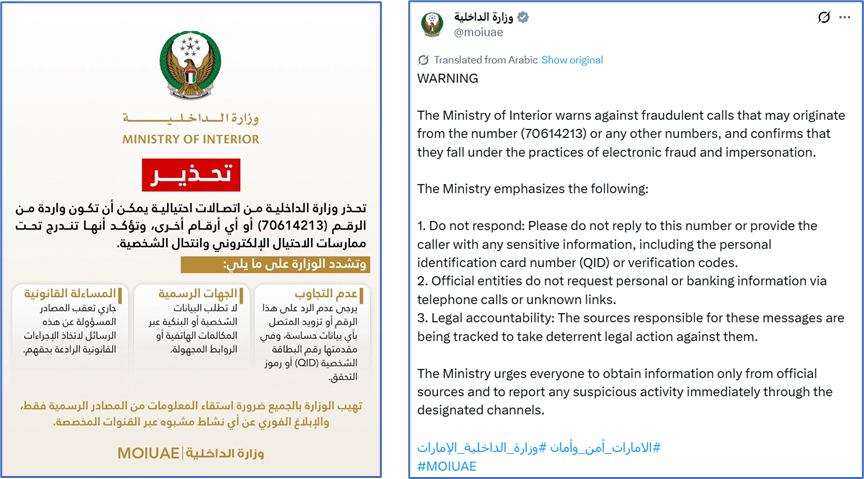
Apart from the cyber escalation, there have been reported cyber-criminal activities in the UAE. Cybercriminals specifically scammers have been actively exploiting the heightened regional uncertainty. Netizens in the UAE are receiving calls from scammer claims to be from the Ministry of Interior (MOI), asking them to confirm receipt of the national alert and requesting that they share their Emirates ID (EID) number for verification purposes.
On March 1, 2026, the Ministry of Interior, UAE (MOI UAE) issued a warning to netizens against fraudulent calls that may originate from the number (70614213) or any other numbers, confirming that these fall under the practices of electronic fraud and impersonation.
CPX Threat Intelligence Centre also observed that Amazon Web Services (AWS) experienced outages affecting data centers in the United Arab Emirates, primarily impacting at least one Availability Zone (mec1-az2) in the me-central-1 (UAE) region. This resulted in loss of power, connectivity issues, and widespread service degradation across critical cloud offerings, such as EC2, RDS, EBS, Lambda, EKS, and networking APIs.
The disruptions were caused by physical debris from a successful UAE interception of incoming projectiles amid the escalating Iran-U.S. and Israel conflict, which inadvertently damaged infrastructure supporting the AWS facilities.
AWS confirmed that restoration efforts were underway, with no confirmed data loss. However, AWS also warned customers that full restoration would take hours, underscoring the risks that physical attacks pose to cloud infrastructure in conflict zones.
The CPX-TIC recommends the following measures:
Defence against DDoS
Defence against ransomware
Defence against web defacement
Defence with IOCs and TTPs
Defence against cybercriminals
Defence against cloud infrastructure
Defence against hacktivist claims on access to ICS/SCADA devices

27 February, 2026
Moltbook: The rise of agent native AI and a new class of threats
Read now

20 February, 2026
Uncovering the Chinese APT Group .Net Malware Payload – Part 2
Read now

19 February, 2026
Uncovering the Chinese APT Group .Net Malware Payload – Part 1
Read now

12 February, 2026
Enabling visibility and monitoring for ICS networks: Fortifying c...
Read now

10 February, 2026
How to secure your Microsoft Exchange Hybrid Environment for 2026
Read now

10 February, 2026
How AI empowers Zero Trust Architecture in network security
Read now

14 January, 2026
Ivanti Connect Secure Forensics (Part 3): Integrity Checker Tool ...
Read now

13 January, 2026
Ivanti Connect Secure Forensics (Part 2): GRUB-based LUKS Decrypt...
Read now

09 January, 2026
Ivanti Connect Secure Incident Response Investigation: From explo...
Read now

26 December, 2025
Zero Trust Architecture: Principles, challenges, and best practices
Read now

08 December, 2025
AI-powered OT cybersecurity: Securing critical infrastructure
Read now
08 December, 2025
AI agents are scaling operations — is risk management ready?
Read now
20 November, 2025
Unmasking a Modern Cyber Assault: Lessons from the Anthropic attack
Read now

02 October, 2025
Filtering the noise: A smarter approach to SCADA security
Read now

18 August, 2025
Detection Engineering Validation: Proven detections for modern SOCs
Read now

30 June, 2025
AI-driven cyber attacks: The rising threat in cybersecurity
Read now

29 May, 2025
How AI copilots in cybersecurity are redefining threat intelligence
Read now

10 April, 2025
Strengthening Azure DevSecOps: Closing gaps with third-party enha...
Read now
28 March, 2025
Oracle Cloud incident: Analyzing the breach and its impact
Read now
08 March, 2024
Enhancing physical security through CPS integration
Read now
20 July, 2023
Understanding Insecure Deserialization
Read now
©CPX 2026. All rights reserved. Privacy policy | Terms of use